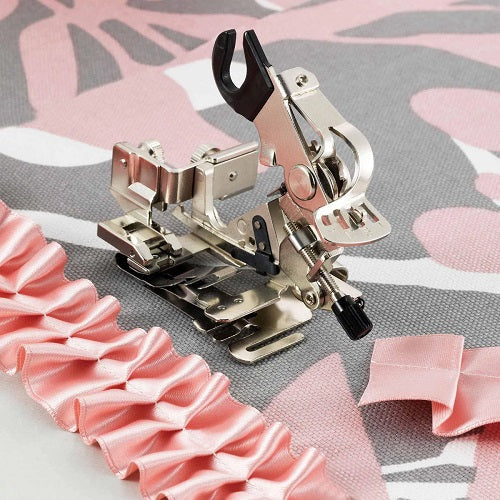

When you’ve been in the sewing machine industry as long as I have, I forget sometimes that there are always new sewers joining the craft and are just learning about tools that I once learned about too! For example, a walking foot. Also known as an even feed foot or a dual feed foot, a walking foot does just what the name says, it “walks” over the fabric as you sew. A traditional presser foot pushes along the fabric, okay for most jobs, but when you are sewing tricky fabrics, a walking foot keeps the top layer from being pushed ahead too fast.
A walking foot consists of a presser foot as well as a second set of feed dogs, similar to those under the presser foot. The walking foot’s feed dog lifts and moves with each stitch, in opposition to the presser foot lifting and lower with each stitch, creating in essence a “clamping” effect to hold the fabric in place with each stitch. This assistance is useful for so many different situations.
Today, using a walking foot is mostly synonymous with quilting, but there was a whole world of sewing before quilting was a thing, and that is why the walking foot was invented. Slinky, slippery knits came out in the late 60s and the home sewing industry needed to make a way for sewers to sew them more easily, born too was the walking foot to solve this issue. The walking foot was also made to keep stripes and plaids matched while sewing, the clamping motion kept the top layer from slipping past the stripe below, some walking feet were even marketed under the name “Plaid Matcher”. Leathers, suedes, vinyls, anything tricky to sew became more manageable with a walking foot. People found sewing two dissimilar fabrics together like a lining fabric to a thick wool coating benefited from the use of a walking foot, and this is how the new scene of quilting in the 90s saw the benefit of the walking foot and made it a quilter’s staple. A fine cotton backing fabric, a lofty batting and a top layer with all those lumps and bumps in the seams, it’s only going to come out right if you use a walking foot.
So, whether you are a new sewer or quilter, or one who’s been sewing for years and just has never thought you needed a walking foot, it’s time to take a look at one. Though one of your more costly tools, it is an investment and with proper care will last as long as your sewing machine.
Before I close, I’d be missing a huge opportunity to encourage you to look back to the blog post titled THE POWER OF CHOICE, about “Sibling Presser Feet”, the walking foot fits into this category. The Non-Stick and Roller presser feet perform similarly to a walking foot when sewing leather, suede and vinyl, but sometimes you need to try one or more on your fabric and situation to find out which is best at the task at hand, and that’s why it’s smart to have more than one “sibling” presser foot. Take a look at that post and you’ll see what I mean!